
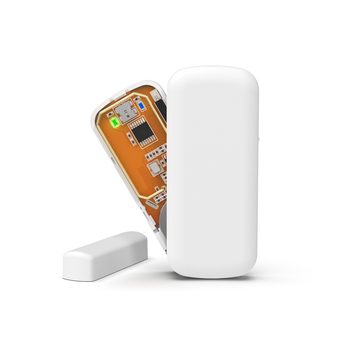


433 MHz sensor - Door and window contact
MINI-433 DSC Wireless Door Contact


A one-way 433 MHz door and window sensor for the DSC PowerSeries PC1832 and PC1864, Impassa and Alexor. It's 0.25 in. deep, runs 5+ years on one CR2032, and the blue Bluefield LED confirms the magnet is in range.
Where to buy the MINI-433


Don't see your distributor? See all Versa distributors ->
At a glance
On this page: Overview Features Setup Specs Panels FAQ
Overview
A 433 MHz DSC wireless door contact that sits flat on the frame
The Versa Wireless MINI-433 is a 433 MHz DSC wireless door contact for the DSC PowerSeries PC1832 and PC1864, the DSC Impassa and the DSC Alexor. It's a one-way 433 MHz door and window sensor that programs as a standard contact zone, and the transmitter measures 2.2 in. x 1 in. x 0.25 in.
At a quarter of an inch deep it sits flat on the frame. That matters on narrow sashes and tight casing, where a thicker contact stands proud of the surface or stops the sash closing. The magnet gap is 1 in. on wood and 1/4 in. on metal, and both pieces mount with the double-faced tape in the box, so a standard opening needs no tools at all.
Here's one thing to know before you mount it. The blue and green LEDs run for 15 minutes after you first install the battery or slide the cover off, then they sleep. That's deliberate, because the lights are an install tool rather than a runtime indicator, and shutting them down is part of how a single CR2032 lasts 5+ years. So if you come back to a sensor you mounted yesterday and the blue light doesn't come on, don't start moving the magnet. Slide the cover off to wake the LEDs for another 15 minutes, then check placement.
To set one up, you put the panel in its wireless enrollment mode, then open or close the magnet to send the device ID. You can also type the serial number in during programming. Zone programming follows your panel's own installation manual, and the full steps are in the MINI-433 installation manual and the MINI-433 datasheet.
Key features
What you get in the box
- A 433 MHz DSC wireless door contact, so it fits the DSC PowerSeries PC1832 and PC1864 with a 433 MHz receiver, the DSC Impassa and the DSC Alexor.
- A single-zone door and window sensor, which programs as a standard contact zone on the panel.
- Only 0.25 in. deep, so it sits flat in narrow window channels and on tight casing.
- A 2.2 in. x 1 in. x 0.25 in. transmitter with a 1 in. x 0.25 in. x 0.25 in. magnet.
- The patented Bluefield magnet alignment indicator, so a blue LED confirms the magnet is in range while you're still at the opening.
- A green LED that flashes on each transmission, and a red LED that flags a low battery about every five seconds for two minutes after a transmission.
- A magnet gap of up to 1 in. on wood and 1/4 in. on metal.
- 5+ years on one battery, a Panasonic CR2032 lithium coin cell you can buy anywhere.
- A slide-off cover, so you change the battery or the color with the sensor still mounted and no tools in your hand.
- Surface mount with double-faced tape in the box for the transmitter and the magnet.
- Rated for 32 to 122 deg F at 95 percent relative humidity, non-condensing.
- Compliant and covered, because it complies with FCC Part 15 and Industry Canada licence-exempt RSSs, and it carries a 2 year warranty.
Setup
Add the MINI-433 to a DSC panel
Fit the battery
Slide the top cover open, fit the CR2032 with the plus side up and slide the cover back the other way. The blue and green LEDs come on for 15 minutes.
Start enrollment on the panel
Put the panel in its wireless enrollment mode. On a PC1832 or PC1864 that means the 433 MHz receiver has to be fitted first.
Send the device ID
When the panel asks for the device, open or close the magnet and the sensor sends its ID. You can type the serial number in instead if you'd rather.
Program the zone and mount it
Finish zone programming the way your panel's installation manual describes. Line the magnet up with the alignment rib, then check that the blue LED lights with the door or window closed before you press the tape down.
Mount the transmitter on the frame, the part that stays still, and the magnet on the door or the opening sash. Keep both away from metal and foil wallpaper, and away from rooms with a lot of metal or electrical wiring like a furnace room. Check your panel's manual for how to confirm RF signal strength before you mount the transmitter for good. Our article on 433 MHz wireless sensors for DSC PowerSeries panels covers the receiver and the panel side in more depth.
Specifications
MINI-433 specifications
433 MHz DSC wireless door contact
| Wireless and RF | |
|---|---|
| Frequency | 433 MHz, one-way |
| Panel compatibility | DSC control panels that support one-way 433 MHz: DSC PowerSeries PC1832 and PC1864 with a 433 MHz receiver such as the RF5132-433, DSC Impassa, and DSC Alexor |
| Enrollment | Programs as a standard contact zone; send the device ID by opening or closing the magnet, or type the serial number in |
| Detection and function | |
|---|---|
| Device type | Single-zone door and window contact transmitter |
| Bluefield magnet alignment indicator | Patented - the blue LED lights when the magnet is within range of the transmitter, 1 in. maximum |
| LED indicators | Blue (magnet in range), green (transmit), red (low battery) |
| Install LED window | Blue and green active for 15 minutes after the battery is first installed or the cover is removed, then they sleep; remove the cover to restart |
| Low-battery signal | Red LED flashes once about every five seconds for two minutes after a transmission |
| Magnet gap (maximum) | 1 in. (25.4 mm) on wood, 1/4 in. (6.35 mm) on metal |
| Physical | |
|---|---|
| Transmitter dimensions | 2.2 in. x 1 in. x 0.25 in. (55.9 mm x 25.4 mm x 6.4 mm) |
| Magnet dimensions | 1 in. x 0.25 in. x 0.25 in. (25.4 mm x 6.35 mm x 6.35 mm) |
| Mounting | Surface mount on the frame, double-faced tape included for the transmitter and the magnet |
| Enclosure | Slide-off cover for tool-free battery and color service; white as shipped, with brown and black cover packs sold separately |
| Power | |
|---|---|
| Battery | 1 x 3VDC 225 mAh lithium coin cell, Panasonic CR2032, fitted plus side up |
| Battery life | 5+ years |
| Environmental | |
|---|---|
| Operating temperature | 32 to 122 deg F (0 to 50 deg C) |
| Relative humidity | 95% non-condensing (UL tested at 85%) |
| Siting | Keep away from moisture, and away from metal or metallic surfaces such as foil wallpaper |
| Regulatory and warranty | |
|---|---|
| Radio compliance | Complies with FCC Part 15 and Industry Canada licence-exempt RSSs |
| Document | MINI-433 installation manual V0000672-01-02 |
| Warranty | 2 years from the original date of consumer purchase |
Keep new and used coin cells away from children. A swallowed coin cell can cause internal chemical burns in as little as two hours and can be fatal; get immediate medical attention if one is swallowed. Do not recharge, disassemble, heat above 212 deg F, or incinerate the battery, and dispose of used cells properly. Use the specified Panasonic CR2032, because another cell may present a risk of fire or explosion. Keep the MINI-433 and magnet away from moisture, and away from metal or metallic surfaces such as foil wallpaper. Keep them out of areas with a large quantity of metal or electrical wiring such as a furnace or utility room. Refer to the installation instructions for the control panel this device is used with for the limitations of the whole alarm system.
Panels
Panels the MINI-433 works with
As a DSC door sensor the MINI-433 works with DSC control panels that support one-way 433 MHz. That's the DSC PowerSeries PC1832 and PC1864 fitted with a 433 MHz receiver such as the RF5132-433, the DSC Impassa, and the DSC Alexor. The Impassa and the Alexor receive 433 MHz already, so they take the MINI-433 as they are, and on all of them it programs as a standard contact zone. The Versa panel compatibility guide matches each Versa frequency to the panels that read it.
Documentation: the MINI-433 installation manual and the MINI-433 datasheet, plus our article on 433 MHz wireless sensors for DSC PowerSeries panels. The door and window sensor range lists all three MINI contacts side by side, and brown and black cover packs match the trim.
FAQ
MINI-433 questions installers ask
What DSC panels does the MINI-433 work with?
As a DSC door sensor the MINI-433 works with DSC control panels that support one-way 433 MHz. That's the DSC PowerSeries PC1832 and PC1864 fitted with a 433 MHz receiver, the DSC Impassa, and the DSC Alexor.
On all of them it programs as a standard contact zone, so you set it up the way you'd set up any other 433 MHz contact on that panel.
Do I need a receiver for a DSC PowerSeries panel?
Yes, on a PC1832 or PC1864. Add a 433 MHz receiver such as the RF5132-433, and the MINI-433 enrolls like any other 433 MHz device on that panel.
The DSC Impassa and the DSC Alexor receive 433 MHz already, so they take the MINI-433 as they are.
How do I add and program the MINI-433 on a DSC panel?
Start enrollment: put the panel in its wireless enrollment mode.
Send the device ID: when the panel asks for the device, open or close the magnet, or type the serial number in instead.
Program the zone: finish zone programming the way your panel's installation manual describes, then check that the blue LED lights with the door or window closed.
How big is the MINI-433, and will it fit a narrow window frame?
The transmitter is 2.2 in. x 1 in. x 0.25 in. and the magnet is 1 in. x 0.25 in. x 0.25 in. The quarter-inch depth is the number that decides most jobs.
It lets the contact sit flat on a narrow sash, instead of standing proud where the sash has to close over it.
What is the magnet gap on the MINI-433?
1 in. on wood and 1/4 in. on metal, both maximums. Metal is tighter because the surface pulls the field. Mount the transmitter on the frame and the magnet on the part that moves. Line the magnet up with the alignment rib, then confirm the blue LED lights with the door or window shut.
The same gap applies when you use it as a DSC wireless window contact on a sliding sash or a casement.
The blue light will not come on. Is the magnet out of range?
Probably not. The blue and green LEDs only run for 15 minutes after you first install the battery or slide the cover off, then they sleep to save power. On a sensor you mounted yesterday they're simply off.
Slide the cover off to wake them for another 15 minutes, then check the gap. If the blue LED still doesn't light with the opening shut, the magnet really is out of range and needs to move closer.
What battery does the MINI-433 use and how long does it last?
One Panasonic CR2032 3VDC lithium coin cell, 225 mAh, rated 5+ years. The cover slides off by hand, so you swap the cell with the sensor still on the frame.
Fit the fresh cell with the plus side up and slide the cover back the other way. The red LED flags a low battery first, flashing about every five seconds for two minutes after a transmission.
What is the difference between the MINI-433, the MINI-319 and the MINI-345?
The frequency, which is set by the panel. The MINI-433 is 433 MHz for DSC, while the MINI-319 is 319.5 MHz for Qolsys IQ panels fitted with the 319.5 MHz SRF card, and for GE/Interlogix. Go with the MINI-345 for 345 MHz, so Honeywell VISTA and Lyric, 2GIG, and Resideo PROA7 with the PROTAKEOVER module.
The housing, the Bluefield indicator, the slide-off cover and the CR2032 are the same across all three. So if you stock the line, you learn one sensor and fit every panel. The door and window sensor range lists all three side by side, and the panel compatibility guide matches each frequency to the panels that read it.


