
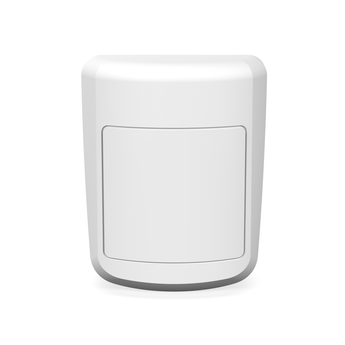


319.5 MHz sensor - Pet-immune motion detector
PIR-319 Pet-Immune Wireless Motion Sensor
A 319.5 MHz motion sensor for Qolsys IQ and GE/Interlogix panels, pet-immune to 55 lb with 40 x 40 ft of coverage. One CR123A runs it 3+ years, and it's the same hardware as the PIR-DUAL fixed on one band.
Where to buy the PIR-319
Ask your Versa distributor for the PIR-319, or contact Versa and we'll point you to the right place to order.
Don't see your distributor? See all Versa distributors ->
At a glance
On this page: Overview Features Setup Specs Panels FAQ
Overview
A pet-immune motion sensor fixed on 319.5 MHz
The Versa Wireless PIR-319 is a pet immune motion sensor for professional alarm panels, fixed at 319.5 MHz, so it's the direct fit for Qolsys IQ and GE/Interlogix accounts. Installers call it a 319.5 MHz motion detector and homeowners search for a Qolsys motion sensor, and both phrases describe this one part. You program it as a standard interior motion zone.
A dual-element passive infrared sensor watches your room through a multi-zone Fresnel lens. It detects motion up to 40 ft in the direction the sensor faces, and 40 ft at 45 degrees, and it's pet-immune up to 55 lb. A digital signal-processing engine confirms real movement before the sensor reports, which cuts false alarms from drafts and sunlight. A sensitivity jumper picks normal or high. Normal alarms after about 3 to 5 steps, and it suits most installations. High alarms after about 2 to 4 steps, for rooms where an intruder only crosses a short distance in view.
Here's the part that only matters if you stock both Versa PIRs. The PIR-319 and the PIR-DUAL are the same platform: same enclosure, same lens, same detection engine, same 55 lb pet mask, same CR123A battery and the same mounting footprint. So one bracket, one spare battery, one set of screw holes and one walk-test procedure cover both parts, and a tech who has commissioned one has commissioned the other. The PIR-319 arrives set for 319.5 MHz, so on a Qolsys or Interlogix job your sequence is battery in, learn in, walk-test.
Mount it 7.5 ft above the floor and aim it so a likely intruder path crosses its view. People are detected best moving across the field of view rather than straight at it. You put the panel in learn mode, insert the battery or open and close the cover, and the panel captures the ID. The sensor is ready about a minute after you power it up. Full figures are in the specifications below, and the panel-by-panel detail is under Panels.
Key features
What you get in the box
- 319.5 MHz, fully supervised, so it's the direct fit for Qolsys IQ and GE/Interlogix panels.
- Pet-immune up to 55 lb, so it's a pet friendly motion sensor that keeps the dog off the panel.
- 40 ft x 40 ft of coverage with a 90-degree field of view, across 98 detection zones. The pattern is drawn under Coverage.
- Dual-element passive infrared detection through a precision multi-zone Fresnel lens.
- Digital false-alarm rejection, because a signal-processing engine confirms real movement before anything reports.
- Selectable sensitivity on the jumper, so normal alarms after about 3 to 5 steps and high after about 2 to 4.
- An LED walk-test that runs while the cover is open and for 5 minutes after it closes, then turns itself off.
- Cover and wall tamper switches, so the panel knows when the lid is off or the unit comes off the wall.
- One CR123A 3V lithium battery, rated for 3+ years, with a supervised low-battery report.
- Millions of unique ID codes, so every sensor enrolls as its own zone.
- Mounts flat on a wall, in a corner, or on the optional bracket, at 7.5 ft above the floor.
- Indoor use, 32 to 122 deg F, FCC Part 15 Class B and IC (ISED Canada), backed by a 2-year warranty.
Coverage
Where the PIR-319 sees, and where pets can go
The PIR-319 covers 40 ft x 40 ft with a 90-degree field of view, mounted 7.5 ft above the floor, and it's pet-immune to 55 lb. The lens splits that fan into 98 narrow zones, so what the detector counts is a person crossing beams, not standing in one. Here's the pattern from the lens data, top view and side view, with the pet zones marked.
90 degrees
field of view
45 degrees each side of centre
40 ft
deep
12 m straight out, 40 ft at 45 degrees
98
detection zones
44 long, 36 mid, 18 short range
7.5 ft
mounting height
2.3 m, flat wall or corner
Top view

Side view, mounted at 7.5 ft

- Green: pets up to 55 lb move here. Floor level, no alarm.
- Amber: keep pets out of here. Shelves, stairs and furniture they can climb, out to 30 ft. A pet up there reads like a person.
- Grey: in between. Depends on the pet. Walk-test it with the pet in the room.
Zones in the top view
- Long-range zones (44) land 30 to 40 ft out and run nearly level.
- Mid-range zones (36) land 10 to 30 ft out.
- Short-range zones (18) look down at the floor within 10 ft.
Mount it at 7.5 ft
Flat on the wall or in a corner, level, 7.5 ft above the floor. The pattern and the pet immunity are rated at that height. Lower, and the long-range beams drop into pet territory; higher, and you lose reach.
Aim across the path
Point it so the way someone would walk through the room crosses the beams. A person walking straight at the sensor crosses fewer zones and is seen later than one walking across it.
Keep the amber zone clear
No shelves, stairs or furniture a pet can climb within 30 ft of the sensor at shelf height. A 55 lb dog on the floor is ignored; the same dog on a couch back 10 ft away is not.
Setup
Add the PIR-319 to a panel
Set the sensitivity and fit the battery
Open the housing and set the jumper to normal or high. Then fit one CR123A, matching plus and minus to the holder, and close the cover, because the sensor is ready about a minute after it powers up.
Put the panel in learn mode
Start your panel's sensor learn mode, so Auto Learn Sensor on a Qolsys panel. On a GE/Interlogix panel it's the sensor learn step in programming.
Make it transmit
Insert the battery or open and close the cover, and your panel captures the sensor's ID. Then you confirm the new zone and give it an interior zone type such as interior follower.
Mount it and walk-test it
Mount it 7.5 ft up, flat on the wall or in a corner, aimed across the walking path as shown in the coverage pattern. Then close the cover and walk the coverage. The LED lights about 2 seconds on each detection for 5 minutes, and you wait about 12 seconds between passes.
Aim the sensor so a likely path through the room crosses its view, because people are detected best moving across the field. Keep windows, sunlight, heaters and vents out of its view. Our guide to 319.5 MHz sensors on the Qolsys IQ Panel 4 and 5 covers the SRF card part numbers and the software level you need.
Specifications
PIR-319 specifications
319.5 MHz pet-immune wireless motion sensor
| Wireless & RF | |
|---|---|
| Frequency | 319.5 MHz (fixed) |
| Panel compatibility | Qolsys IQ Panel 5, IQ Panel 4 and IQ Panel 2+ (each with the Qolsys 319.5 MHz SRF card); GE/Interlogix 319.5 MHz panels |
| Supervision | Fully supervised; millions of unique ID codes |
| Detection & function | |
|---|---|
| Device type | Dual-element PIR motion detector (passive infrared motion sensor) |
| Pet immunity | Up to 55 lb - dual-element pyroelectric |
| Coverage | 40 ft x 40 ft (12 m x 12 m) - 40 ft in the sensor-facing direction and 40 ft at 45 degrees to each side. See the coverage pattern |
| Field of view | 90 degrees |
| Lens | Precision multi-zone Fresnel - divides the area into alternating detection zones |
| Detection zones | 98 optical fields of view - 44 long-range (land 30 to 40 ft), 36 mid-range (10 to 30 ft), 18 short-range (0 to 10 ft) |
| False-alarm rejection | Digital signal-processing engine |
| Sensitivity | Jumper-selectable - normal (alarm after about 3 to 5 steps) or high (about 2 to 4 steps) |
| Walk-test | The alarm LED is active only while the cover (tamper) is open and for 5 minutes after it closes. It lights about 2 seconds per detection; allow about 12 seconds between passes. Then it auto-disables |
| Indicators | LED flashes at power-up (power-up message sent); lights 2 seconds on detection during the walk-test window; low-battery indication |
| Report hold-off | 3 minutes between reports in normal operation |
| Tamper | Cover and wall tamper switches |
| Physical | |
|---|---|
| Dimensions | 2.9 x 2.4 x 1.7 in. (73.5 x 60.5 x 43.5 mm), H x W x D |
| Mounting height | 7.5 ft (2.3 m) above the floor - the coverage pattern and the 55 lb pet immunity are rated at this height |
| Mounting | Flat wall (within 2 degrees of vertical), corner, or optional bracket (within 15 degrees on a semi-vertical surface, sensor held vertical within 2 degrees). Screws through the base, or the three adhesive strips supplied |
| Power | |
|---|---|
| Battery | 1 x CR123A (3V lithium), replaceable, fitted to the plus and minus marks in the holder |
| Battery life | 3+ years - supervised low-battery report |
| Operating conditions | |
|---|---|
| Operating temperature | 32 to 122 deg F (0 to 50 deg C) |
| Use | Indoor - residential and light-commercial security systems |
| Compliance & warranty | |
|---|---|
| Radio compliance | FCC Part 15 Class B; IC (ISED Canada) licence-exempt RSS |
| Warranty | 2 years from the original date of consumer purchase |
Installation notes: mount the PIR-319 indoors on a vertical wall or in a corner, 7.5 ft above the floor, with a clear line of sight across the area you are protecting. Aim it away from windows, direct sunlight, heaters and heating or cooling vents, and keep glass out of its view - infrared does not pass through it. Walk-test after every install and at least once a year afterwards. Use one CR123A 3V lithium battery with correct polarity. Risk of fire, explosion and burns: do not recharge, disassemble, puncture, short-circuit, heat above 212 deg F (100 deg C), or incinerate. Keep batteries away from children and dispose of used cells per local regulations. Install and operate the sensor with at least 20 cm (8 in.) between the radiator and any person, per the FCC RF-exposure limits for an uncontrolled environment. This sensor is a supplemental security device, not a substitute for safe practices or proper system design. Like all sensors it can fail to detect for many reasons, including a dead or low battery, a blocked or obstructed view, coverage gaps, or component failure. Test the system regularly, and refer to the control panel's installation instructions for the limitations of the whole alarm system.
Panels
Panels the PIR-319 works with
The PIR-319 enrolls on the Qolsys IQ Panel 4, the IQ Panel 5 and the IQ Panel 2+. Each of those panels reads 319.5 MHz through the Qolsys 319.5 MHz SRF card, so the card has to be fitted for the sensor to learn in. Then you use Auto Learn Sensor and pick an interior zone type. It also enrolls on GE/Interlogix 319.5 MHz panels. On the same 319.5 MHz account you can pair it with the MINI-319 door and window sensor and the SHOCK-319 shock sensor. So one frequency covers your doors, windows and rooms.
Documentation: specifications and mounting detail live in the Versa installation manuals and datasheets library. Our guide to 319.5 MHz sensors and the SRF card walks through which panels take which card. The Versa panel compatibility guide covers the whole sensor line, and the wireless motion detector guide compares the two Versa PIRs side by side. The dealer guide to the Versa sensor line shows the full 319.5, 345 and 433 MHz lineup, and both Versa PIRs sit in the wireless motion detectors collection.
FAQ
PIR-319 questions installers ask
Is the PIR-319 a pet-immune motion sensor, and up to what weight?
Yes. The PIR-319 is pet-immune up to 55 lb. Two pyroelectric elements alternate in polarity, and the engine only declares an alarm on a qualified sequence of polarity changes. That sequence improves immunity to drafts, sunlight and other nuisance sources, and motion detection still fires on a person crossing the room.
You mount it 7.5 ft above the floor to get the rated behaviour, and you give it a clear view across the area you're protecting. Height is the part installers underrate. The lens divides the room into alternating detection zones, so mounting high enough keeps pets in the lower part of the coverage. If a pet does trip the zone, you raise the sensor rather than drop the sensitivity.
What panels is the PIR-319 compatible with?
The PIR-319 runs at 319.5 MHz, so it enrolls on the Qolsys IQ Panel 4, IQ Panel 5 and IQ Panel 2+, and on GE/Interlogix 319.5 MHz panels. You program it as a standard interior motion zone.
One requirement to plan for on the Qolsys side. The IQ Panel 4, IQ Panel 5 and IQ Panel 2+ read 319.5 MHz through the Qolsys 319.5 MHz SRF card, so that card has to be installed in the panel before the sensor will learn in.
How do I add the PIR-319 to a panel and walk-test it?
Add it: put the panel in learn mode, then insert the battery or open and close the cover to send a signal. On a Qolsys panel you use Auto Learn Sensor. Confirm the panel added the zone, then assign an interior zone type such as interior follower.
Walk-test it: the alarm LED is active while the cover is open, and for 5 minutes after you close it. In that window the LED lights about 2 seconds on each detection. So you walk across the coverage, wait for the LED to go out, then wait about 12 seconds before the next pass.
Then leave it: after 5 minutes the LED disables itself and the sensor runs normally. The sensor is fully operational about a minute after you power it up, and you walk-test it again at least once a year.
How far does the PIR-319 see?
The PIR-319 covers 40 ft x 40 ft with a 90-degree field of view: 40 ft straight out and 40 ft at 45 degrees to each side, mounted 7.5 ft above the floor. The lens splits that fan into 98 zones, 44 long-range, 36 mid-range and 18 short-range, and the coverage pattern on this page shows where each tier lands. So corner mounting uses that spread to cover a room with one device.
Aim matters more than reach. People are detected best moving across the field of view rather than straight at it, so you point the sensor so a likely path through the room crosses its view.
Why does the PIR-319 not report every pass?
Because a 3-minute hold-off runs between reports in normal operation. Walk past it twice in a minute and you won't get a second report. That's by design, and it's what keeps a busy room from flooding the panel and draining the battery.
If you want to see every pass, use the walk-test window instead. The LED lights on each detection while the cover is open and for 5 minutes after it closes, with about 12 seconds between passes.
Where should I mount the PIR-319 so pets do not trip it?
Mount it 7.5 ft above the floor, flat on a wall or in a corner, and aim it so the way people walk through the room crosses its view. At that height the long-range beams pass over a pet up to 55 lb on the floor, which is the green zone in the coverage pattern on this page.
The amber zone is the one to respect: from about 5 ft up to the sensor height, out to 30 ft. A pet that climbs onto a shelf, a couch back or the stairs inside that zone reads like a person. So keep climbable furniture out of it, and walk-test with the pet in the room before you leave.
What battery does the PIR-319 use and how long does it last?
One CR123A 3V lithium battery, with 3+ years of typical life. The sensor supervises itself and sends a low-battery report to the panel, so you get warning before it goes quiet. The same cell fits the PIR-DUAL, so one spare covers both.
How is the PIR-319 different from the PIR-DUAL?
The frequency. The PIR-319 is set for 319.5 MHz, which is the direct fit when your account is Qolsys IQ or GE/Interlogix.
The PIR-DUAL adds a 345 MHz setting, so one part also covers Honeywell, Resideo and 2GIG. You pick it when a single truck stock has to serve mixed panels. Everything else is common to both: 55 lb pet immunity, 40 ft coverage, the same lens and detection engine, one CR123A, and the same mounting footprint. See both in the Versa wireless motion detectors collection.


