
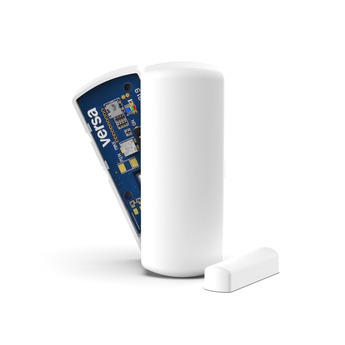


SHOCK-319


The Versa Wireless SHOCK-319 is a wireless shock sensor and door/window contact in one 319.5 MHz device. It mounts on the frame of a door or window and catches the impact and vibration of a forced-entry attempt. Prying, kicking and striking all register. The alarm trips while the attack is still happening, on one supervised zone.
As a window shock sensor it goes on the sash or the frame, never on the glass itself. The magnet mounts on the moving part, so the same unit also reports the opening as an ordinary door/window contact. A DIP switch marked REED SW turns that contact on or off. On the shock side, a small screwdriver dial marked MIN and MAX sets how hard an impact has to be before the sensor fires.
What makes that dial workable is the pre-shock indication. The sensor flashes green when an impact came close to the threshold without reaching it, and lights red when the shock alarm fires. That turns tuning into a live read rather than a guess. Strike the surface with your palm and add pressure, or turn the dial clockwise with a small screwdriver. Stop at the response you want for that opening. Do it with the unit mounted. Vibration reaches the sensor through the surface it is taped to, so the setting has to be found on the actual door or window.
Setup is short. Set the DIP switch first. Run your panel's Go/No Go test at the spot before you mount anything permanently. Then tape the transmitter to the frame and the magnet to the moving part, and check that the blue Bluefield LED lights when the opening is closed. Then put the panel in autolearn and tap the cover so the sensor sends its serial number. Every figure is in the Specifications tab, and the step-by-step is in the SHOCK-319 installation manual.
Key features
- Wireless shock sensor and door/window contact on a single supervised 319.5 MHz zone
- Detects the impact and vibration of forced entry: prying, kicking, striking the door, window or frame
- Mounts on the frame or sash of the protected opening
- Adjustable shock sensitivity on a screwdriver dial, marked MIN and MAX on the board
- Green pre-shock LED and red alarm LED let you tune from the mounted position
- REED SW DIP switch: ON adds the door/window contact, OFF is shock only
- Patented Bluefield blue LED confirms magnet placement during install
- Slide-off lid for tool-free battery and color service with the unit still mounted
- Tamper trips on cover removal
- 8+ year battery life on a 3V Versa CR2U lithium battery
- UL, FCC and IC listed. FCC ID 2AD9XSHOCK319
- 2-year warranty
SHOCK-319 specifications
319.5 MHz door/window contact and shock sensor
| Wireless and RF | |
|---|---|
| Frequency | 319.5 MHz |
| Panel compatibility | Qolsys IQ Panel 5, IQ Panel 4 and IQ Panel 2+ (each with the 319.5 MHz SRF card), and GE/Interlogix-class 319.5 MHz panels |
| Supervision | Fully supervised transmitter |
| Enrollment | Built-in serial number, learned in autolearn mode as a standard supervised zone |
| Detection and function | |
| Device type | Dual-function door/window contact and adjustable shock sensor |
| Shock sensitivity | Adjustable on a screwdriver dial, marked MIN and MAX on the board |
| Reed switch (DIP) | Board marked REED SW. ON enables the internal reed, so the device reports shock and the door/window contact. OFF disables it, so the device reports shock only and the reed and magnet go unused |
| LED indicators | Blue (magnet in range), green (pre-shock), red (shock alarm) |
| Bluefield magnet indicator Patented | Blue LED confirms the magnet is in range during install, and stays active for 5 minutes after the battery goes in or the cover comes off |
| Magnet gap (max) | 1 in. on wood, 1/4 in. on metal (25.4 mm, 6.35 mm) |
| Physical | |
| Dimensions (L x W x H) | 2.85 x 1.15 x 0.75 in. (73 x 30 x 19 mm) |
| Mounting | Surface mount, double-faced tape included |
| Tamper | Trips on cover removal |
| Enclosure | Slide-off lid for tool-free service access |
| Power | |
| Battery | 1 x 3V lithium, Versa CR2U (or Panasonic CR2) |
| Battery life | 8+ years |
| Environmental | |
| Operating temperature | 32 to 122 deg F (0 to 50 deg C) |
| Use | Indoor, residential and commercial |
| Certifications and warranty | |
| Agency listings | UL, FCC and IC |
| FCC ID | 2AD9XSHOCK319 |
| Radio compliance | Complies with FCC Part 15 and with the licence-exempt RSS standards administered by the ISED Certification and Engineering Bureau |
| Warranty | 2 years |
Replace the battery only with a Versa CR2U or a Panasonic CR2; another type may present a risk of fire or explosion. Do not recharge, disassemble, heat above 212 deg F (100 deg C) or incinerate a cell, and keep cells away from children. Shock detection is not evaluated by UL. Install the SHOCK-319 on door and window frames, with or without glass inserts, and not on the glass surface itself. Do not apply pressure to glass while setting sensitivity. Keep the sensor and magnet clear of metal and heavy electrical wiring, and out of damp locations or anywhere the temperature runs outside 32 to 122 deg F.
Compatible panels and controllers
The SHOCK-319 runs at 319.5 MHz and programs as a standard supervised zone. It works with the Qolsys IQ Panel 5, IQ Panel 4 and IQ Panel 2+, each with the 319.5 MHz SRF card installed, and with GE/Interlogix-class 319.5 MHz panels. Put the panel in autolearn, open or close the magnet or tap the cover, name the zone and save. The Versa panel compatibility guide covers the SRF card and the other panel families in detail.
SHOCK-319 questions installers ask
What does the SHOCK-319 detect, and is it a glassbreak sensor?
It detects impact and vibration in the surface it is mounted to. That is what a forced-entry attempt produces: prying at a sash, kicking a door, drilling or striking a frame. The alarm goes in while the attack is happening.
It is not a glassbreak detector. A glassbreak sensor is an acoustic device that sits in the room and listens for the sound of glass shattering. The SHOCK-319 is a vibration detector that sits on the frame and feels the attack. The two cover different failure modes and many jobs use both.
Can I use the SHOCK-319 as a window shock sensor?
Yes. That is the common use. Mount the transmitter on the window frame or the sash and the magnet on the part that moves. A vulnerable window then reports two things on one zone: someone opening it, and someone attacking it while it is still closed.
As a shock sensor for windows it goes on the frame or the sash. The manual puts the transmitter on the frame of the protected window, with or without glass inserts, and the magnet on the part that moves.
Which panels work with the SHOCK-319?
Any 319.5 MHz security panel that takes a standard supervised zone. That means the Qolsys IQ Panel 5, IQ Panel 4 and IQ Panel 2+, each with the 319.5 MHz SRF card installed, and GE/Interlogix-class 319.5 MHz panels. The SRF card is what lets a Qolsys panel hear 319.5 MHz sensors at all, so check for it before you order.
How do I add, pair or enroll the SHOCK-319?
Put the panel in autolearn. Open the panel's programming menu and start autolearn mode.
Make the sensor transmit. Open or close the magnet, or tap the cover. The SHOCK-319 sends its built-in serial number.
Name and save. Set the zone name and settings on the panel, then save. It enrolls as a standard supervised zone, the same as any other 319.5 MHz contact.
How do I set the shock sensitivity?
Mount the unit first, then tune it. Strike the surface gently with the palm of your hand and build up pressure, or turn the sensitivity dial clockwise with a small screwdriver, until you get the response you want. The dial is marked MIN and MAX on the board.
Use the LEDs to find the margin. Green flashes on a pre-shock reading, meaning the impact came close to the threshold without reaching it. Red lights only when the shock alarm fires. Tuning until you see green tells you where the threshold sits without setting off the panel.
Then confirm it stays quiet in normal use. Normal traffic, normal opening and closing, wind and window coverings should not trip it, because that is where false alarms come from. Do not stress or damage the mounting surface while you test.
What does the DIP switch on the SHOCK-319 do?
It enables or disables the internal reed switch, which is the door/window contact. The board marks it REED SW.
Set to ON, the device reports both the shock sensor and the door/window contact, using the supplied magnet. Set to OFF, it reports shock only, and the reed and magnet go unused. The shock sensor works either way.
Can the SHOCK-319 be mounted on glass?
Mount it on the frame of the protected door or window, with or without glass inserts, and on the sash rather than the glass panel. Put the transmitter on the part that stays still and the magnet on the part that moves. The safety note in the Specifications tab covers the rest, including what to avoid while you are setting sensitivity.
What battery does the SHOCK-319 use and how long does it last?
One 3V Versa CR2U lithium battery, rated for 8+ years. Replace it with a Versa CR2U or a Panasonic CR2. Battery handling is covered in the safety note in the Specifications tab.
The slide-off lid means you can change the battery, or swap the color cover, with the sensor still mounted on the frame. Taking the cover off is a monitored event, so disarm or put the system in test mode first.
How is the SHOCK-319 different from the MINI-319?
Both run at 319.5 MHz and both carry the Bluefield magnet indicator, so they enroll the same way on the same panels. The difference is what they watch. The MINI-319 is a door/window contact: it reports the opening, and at 0.25 in. deep it sits nearly flush on tight casing.
The SHOCK-319 does that job and adds shock detection on the same zone, in a larger 0.75 in. deep body with a CR2 lithium cell. Use the MINI-319 on ordinary openings and the SHOCK-319 where the opening itself is a likely attack point. Both sit in the door and window sensor range.
The SHOCK-319 is available direct here, through WAVE Electronics distribution, and on Amazon. Dealers and integrators can open a Versa wholesale account for trade pricing, or contact Versa Wireless with an application question. Browse the full wireless shock sensor range.


